

Can I Ever Stop Taking a GLP-1? Finding Your Long-Term Maintenance Plan
It is the most common question once the scale starts moving: "Is this a 'forever' drug, or is there a way out?"
The conversation around stopping GLP-1 medications like Wegovy, Zepbound, or compounded alternatives is evolving. While clinical trials show that many people regain weight when stopping abruptly, there is a growing community of people who have successfully "weaned off" while keeping the weight off.
The secret isn't luck—it's a combination of a structured medical taper and the permanent adoption of lifestyle "anchors" developed while on the medication.
The Reality: Why Maintenance Matters
For many, obesity is a chronic metabolic condition. Just as you wouldn't stop wearing glasses because your vision is currently clear, many people find that the medication provides the "biological correction" they need indefinitely.
However, successful cessation is possible. Success is defined as stopping the medication while maintaining at least 80%–90% of your weight loss for over a year.
The Blueprint for a Successful Exit
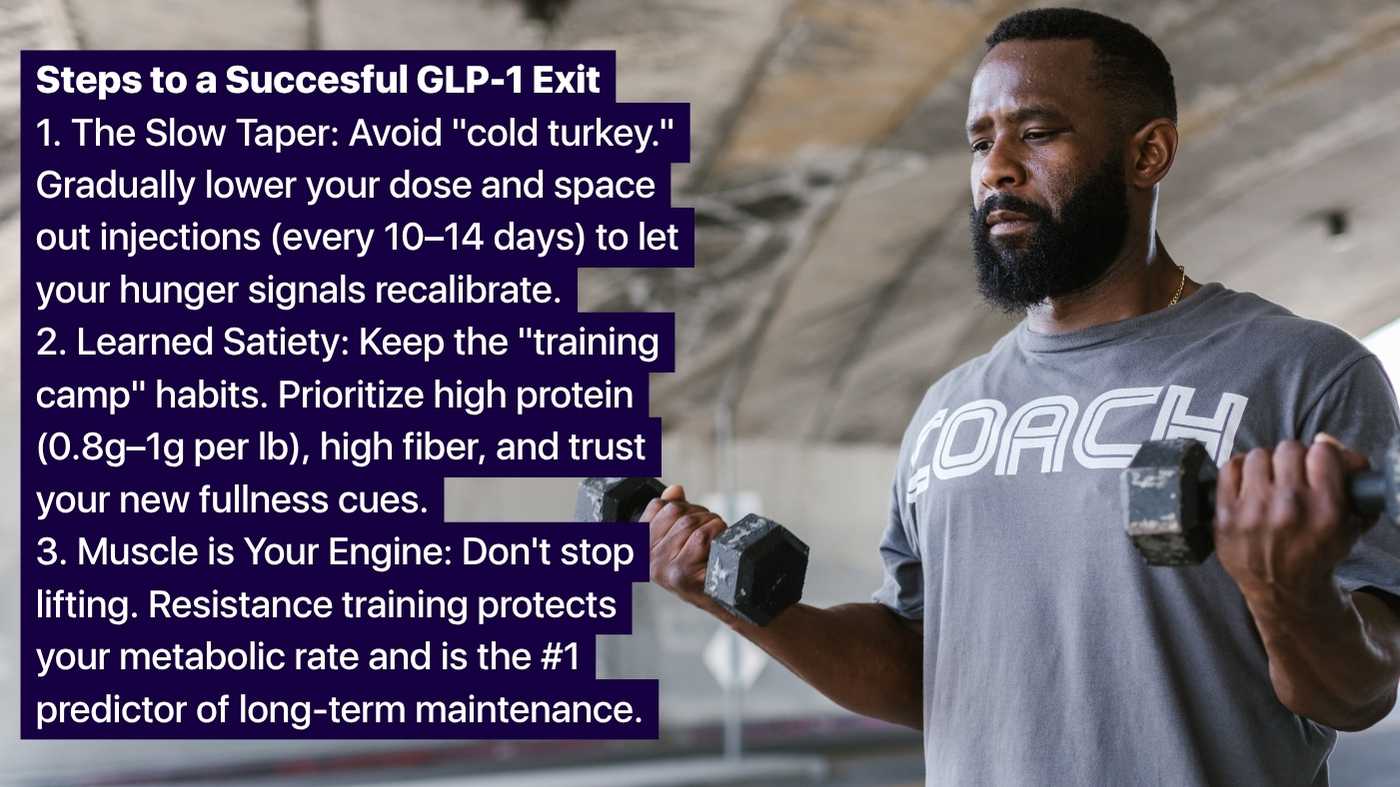
If you want to transition off a GLP-1, you shouldn't just stop. You need a transition plan that focuses on three pillars:
1. The Slow Taper (The "Step-Down" Method)
Stopping "cold turkey" can cause a hormonal surge of hunger. A successful weaning process usually involves:
- Spacing out doses: Instead of injecting every 7 days, your doctor may move you to every 10 days, then every 14 days.
- Lowering the dose: Gradually moving down from a 2.4mg or 15mg dose back through the titration steps (1.7mg→1.0mg, etc.). This gives your brain and gut time to recalibrate their own signaling without the sudden "drop-off" of the medication.
2. Leveraging "Learned Satiety"
The most successful "weaners" are those who treated their time on the GLP-1 as a "training camp." They didn't just eat less; they learned how to eat.
- Volume Eating: Using high-fiber, low-calorie foods to physically fill the stomach.
- The Protein Anchor: Maintaining a high protein intake (0.8g to 1g per pound of goal body weight) to naturally suppress ghrelin (the hunger hormone).
- Intuitive Signaling: Using the "quiet" period on the drug to learn what physical fullness actually feels like, then practicing those cues as the drug wears off.
3. Protecting the Metabolism with Muscle
The biggest risk of stopping a GLP-1 is a lowered metabolic rate. If you lost muscle during your weight loss, your body burns fewer calories at rest, making regain easier.
- Success Factor: Those who prioritize resistance training while on the medication are significantly more likely to keep weight off after stopping. Muscle acts as a "metabolic engine" that works even when the medication is gone.
What the Data Actually Says
Recent 2026 real-world studies show that while weight regain is common, it is not a guarantee.¹
- The 1 in 3 Rule: Approximately 32% of patients in recent cohort studies maintained their weight within 5 lbs one year after stopping the medication.²
- The Common Thread: These "maintainers" all reported consistent exercise (200+ minutes per week) and a high-protein diet as their primary tools for success.
A "Middle Ground": The Maintenance Dose
If stopping entirely feels too risky, many people find success in a "middle ground" strategy.
- Micro-Dosing: Using a very small dose (like 0.25mg of semaglutide or 2.5mg of tirzepatide) every 10–14 days.
- The Benefit: This provides just enough "background support" to keep food noise manageable while allowing the patient to handle the bulk of the work through their new lifestyle habits. This is particularly easy to manage with compounded options, where doses can be customized to the drop.
Summary: Your GLP-1 Exit Strategy
Stopping a GLP-1 is a transition, not an ending. If you have spent your months on the medication building a foundation of muscle, learning to prioritize protein, and mastering your hunger cues, you are a prime candidate for a successful taper.
Ready to start your weight loss journey?
Want to see if GobyMeds is a good fit for you? Start your consultation today to see if you qualify.
References
- JAMA Network Open (2026). Weight Loss Outcomes Among Patients with Obesity Treated with Semaglutide in a Real-World Setting. https://jamanetwork.com/journals/jamanetworkopen/fullarticle/2815345
- Nference & Mayo Clinic (2025). Decoding the hallmarks of GLP-1RA weight-loss super-responders: A real-world data analysis. https://www.medrxiv.org/content/10.1101/2025.11.15.25340314v1
- Eli Lilly & Co. (2025). SURMOUNT-5: A Head-to-Head Study of Tirzepatide vs. Semaglutide in Patients with Obesity. https://investor.lilly.com/news-releases/news-release-details/lillys-tirzepatide-achieved-superior-weight-loss-compared-0




.svg)