
Do Additives Dilute Compounded Semaglutide and Compounded Tirzepatide and Make Them Less Effective?
If you have ever looked closely at a compounded GLP-1 prescription, you may have noticed that some formulations include more than just semaglutide or tirzepatide. Depending on the pharmacy, a compounded product may be marketed as containing another ingredient alongside the GLP-1, often with the suggestion that the extra ingredient supports energy, tolerability, or some other benefit.
That naturally raises a fair question:
If another ingredient is added, does that dilute the medication and make it less effective?
The short answer is: not automatically.
An additive does not inherently “water down” compounded semaglutide or compounded tirzepatide if the product is accurately compounded and you are still receiving the intended dose of the GLP-1. What matters most is the amount of active drug you actually receive, the concentration in the vial, the quality of the compounded product, and whether the dosing instructions are accurate and easy to follow.[1][2][3]
That said, there is also an important catch: compounded drugs are not FDA-approved, which means the FDA does not review their safety, effectiveness, or quality before they are marketed.[4] So while additives do not automatically make a compounded GLP-1 weaker, added complexity can create more room for confusion, dosing mistakes, and quality questions.
Let’s break that down clearly.
What People Usually Mean by “Dilute”
When patients ask whether additives “dilute” compounded semaglutide or tirzepatide, they are usually asking one of two things:
- Does adding another ingredient reduce how much semaglutide or tirzepatide I’m getting?
- Does adding another ingredient make the GLP-1 work worse?
Those are related questions, but they are not exactly the same.
Dose and concentration are not the same thing
This is the key concept that clears up most of the confusion.
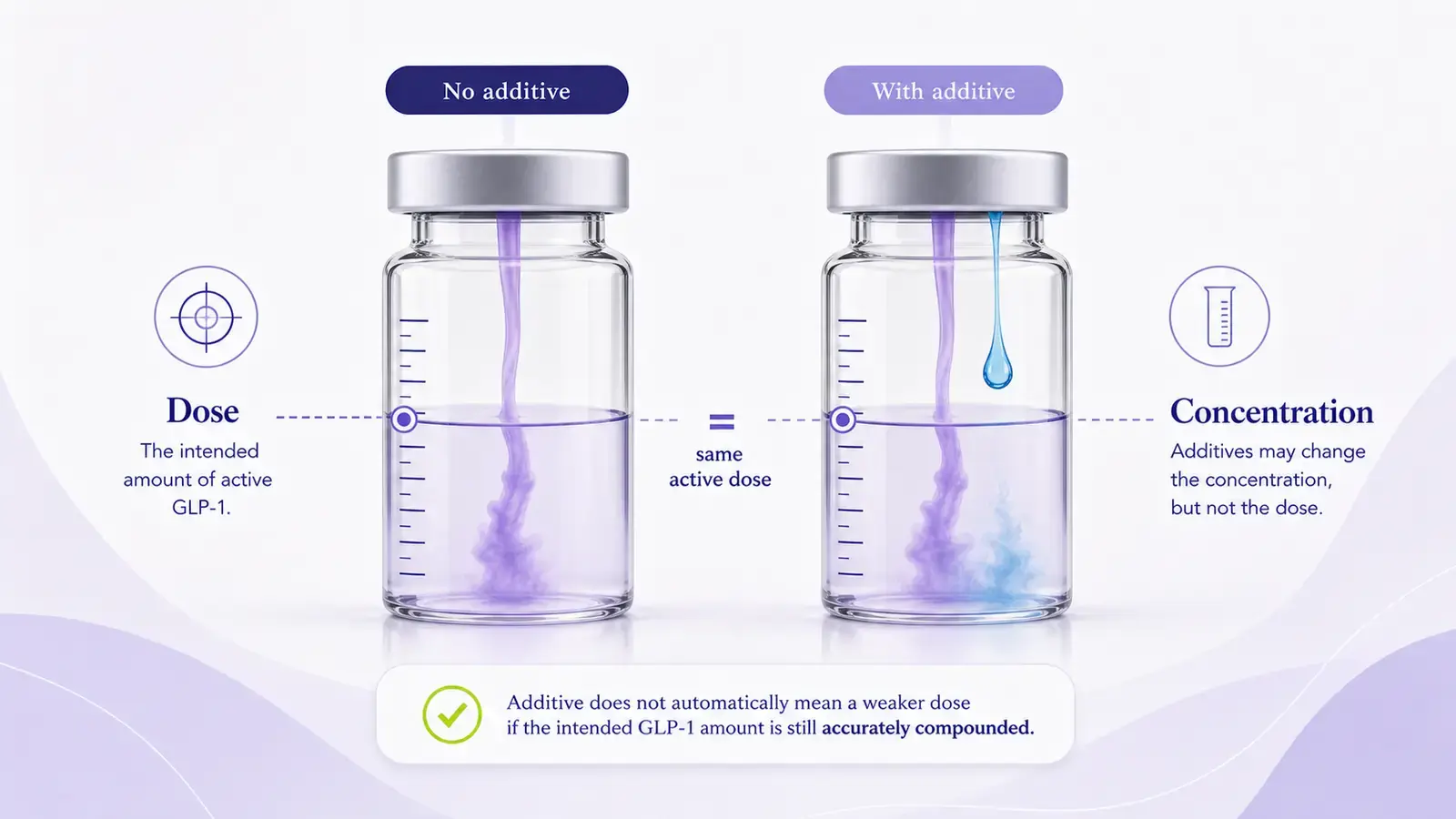
If a vial contains the intended amount of semaglutide or tirzepatide, adding another ingredient does not automatically reduce the actual milligram dose of the GLP-1 you receive. It may change the concentration or the volume you inject, but that is different from changing the dose itself.
For example, if a compounded formulation is made so that your prescribed dose still delivers the correct amount of semaglutide, then the fact that another ingredient is also present does not automatically make the semaglutide weaker. In simple terms, more ingredients in the vial do not necessarily mean less active GLP-1 per dose.
What matters is whether the formulation is compounded correctly and whether the instructions match the concentration.
When Additives Do Not Automatically Reduce Effectiveness
If a compounded product is made correctly, an additive does not inherently cancel out or weaken semaglutide or tirzepatide.
That is the most important takeaway.
In other words:
- If the pharmacy compounds the intended amount of semaglutide or tirzepatide into the final product,
- If the concentration is clearly labeled,
- If the patient measures the correct dose,
- If the product is stable and high quality,
then an additive does not automatically make the GLP-1 less effective.
This is really a compounding and dosing issue, not a simple “more ingredients equals weaker medicine” issue.
In fact, the FDA has specifically noted that a compounded drug product that combines semaglutide API with another API, such as vitamin B12, may still be considered essentially a copy of commercially available drug products under certain conditions.[1] That point matters because it reinforces a basic idea: adding another ingredient does not automatically transform semaglutide into something fundamentally weaker or different.
What Actually Can Make a Compounded GLP-1 Feel Less Effective?
This is where the conversation gets more practical.
If a patient feels that a compounded GLP-1 is “not working,” the reason is usually not as simple as “it had an additive in it.”
More often, the real issues are things like:
- The actual GLP-1 dose is lower than the patient thinks
- The concentration changed and dosing instructions were confusing
- The patient drew up the wrong volume
- The titration schedule was too low, too high, or too fast
- The compounded product was poor quality
- The patient is comparing a different formulation, different source, or different strength
Those factors matter much more than the mere presence of another ingredient.
The Real Risk: Confusion About Concentration and Dose
One of the clearest FDA concerns around compounded semaglutide has nothing to do with additives being inherently bad. It has to do with dosing errors.[2][3]
FDA has warned that compounded injectable semaglutide may come in varying concentrations, and some instructions may be written in “units” rather than milligrams or milliliters.[2] That creates room for confusion when patients are trying to translate a prescribed dose into the amount they actually need to draw up in a syringe.
This matters because two vials can both contain semaglutide, but if they have different concentrations, the number of units that corresponds to a given dose may be very different.
That is where patients can get into trouble.
So if someone says, “This compounded version feels weaker,” sometimes the issue is not potency at all. Sometimes it is that the person is unintentionally taking less medication than intended because the math or instructions were confusing.
That is one reason why any compounded product, especially one with a more customized formula, should come with very clear dosing guidance.
What About Tirzepatide?
The same basic logic applies to compounded tirzepatide.
If the intended tirzepatide dose is accurately compounded and clearly dosed, another ingredient in the formula does not automatically make the tirzepatide less effective.
But the same caution still applies:
- Compounded tirzepatide is not FDA-approved[4]
- FDA has received adverse event reports related to compounded tirzepatide[3]
- Incorrect dosing, unclear concentration, or poor-quality sourcing can absolutely affect the patient experience[1][3]
So while the additive itself is not automatically the problem, the more complicated the formulation and instructions become, the more important quality control and clear dosing become too.
Additives Are Not the Same Thing as the Wrong Active Ingredient
This is a distinction patients should understand, especially with semaglutide.
An additive is one thing.
Using the wrong active ingredient is another.
FDA has specifically warned that some compounded semaglutide products may use salt forms such as semaglutide sodium or semaglutide acetate. FDA states these are different active ingredients than the semaglutide used in the approved drugs, and the agency says it does not have information showing they have the same chemical and pharmacologic properties as the approved active ingredient.[3]
That is not just an “additive” issue. That is a separate and much more serious formulation issue.
So if patients are worried about whether a compounded GLP-1 is truly equivalent in effect, the biggest red flags are usually not harmless-sounding extras alone. The bigger concerns are:
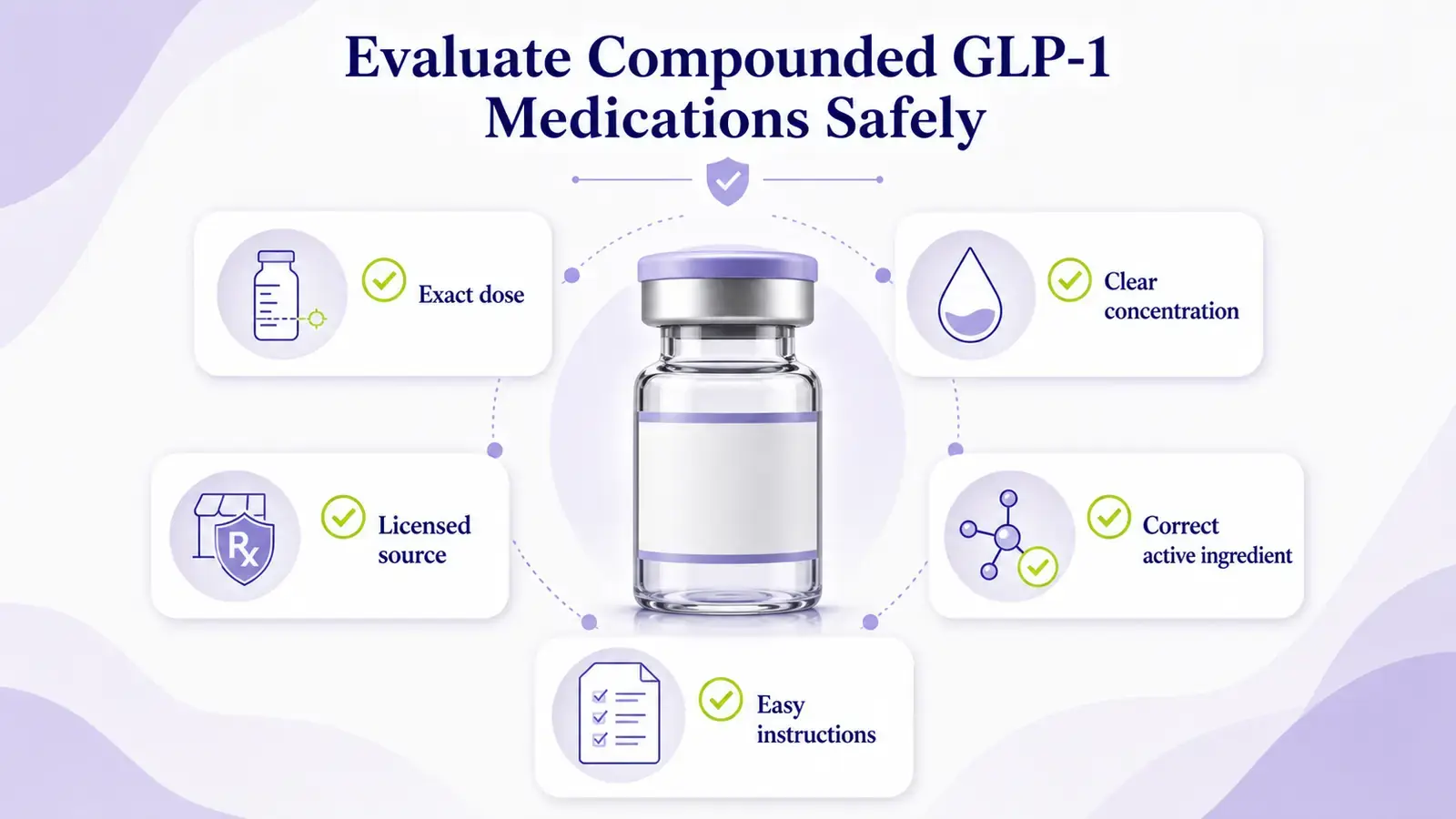
- Whether the product is from a licensed, legitimate source
- Whether the product uses the correct active ingredient
- Whether the concentration and dose are clearly explained
- Whether the compound was prepared to appropriate quality standards
Why Some Pharmacies Add Ingredients at All
Different pharmacies or prescribers may use compounded combinations for different reasons. In some cases, an additional ingredient may be intended to create a formulation tailored to a patient’s needs. In other cases, it may be included as part of how the product is marketed.
The important point is that an additive should not be treated like proof that the product is better, worse, stronger, or weaker on its own.
You still need to ask:
- What is the actual semaglutide or tirzepatide dose per injection?
- What is the concentration in the vial?
- How many milligrams am I taking each week?
- Is the source reputable and state-licensed?
- Are the instructions easy to follow?
Those questions are much more useful than focusing only on whether an ingredient was added.
How GobyMeds Approaches Dose Accuracy
At GobyMeds, the important point is not simply whether an additive is present. It is whether the patient is still receiving the prescribed amount of semaglutide or tirzepatide in each dose.
The pharmacies GobyMeds works with compound the medication so that the volume and concentration in the vial align with the prescribed dosage. In practical terms, that means if an additive is included in the formulation, the compound is adjusted accordingly so the patient still receives the intended amount of the GLP-1 per dose.
That is the key distinction.
An additive does not inherently reduce the medication’s strength or effectiveness when the product is compounded correctly and the dose, concentration, and instructions are matched appropriately. The goal is to make sure the patient receives exactly what was prescribed, not a weaker version of it.
This is also why clear labeling and dosing instructions matter so much. If the concentration in the vial and the dosing directions are built correctly around the prescribed dose, then the presence of an additive does not automatically mean the medication has been “diluted” in a way that reduces its clinical effect.
Does the FDA Review These Additive Combinations?
No.
This is one of the most important limitations in the whole discussion.
Compounded drugs are not FDA-approved, and FDA does not review their safety, effectiveness, or quality before they are marketed.[4] That means the agency is not confirming that a given compounded semaglutide-plus-additive or tirzepatide-plus-additive formula performs exactly like an FDA-approved product.
So if someone says, “This compounded semaglutide with an additive is definitely just as effective,” that claim should be treated carefully.
A more accurate statement is:
An additive does not automatically make the GLP-1 less effective, but compounded formulations are not FDA-reviewed, and their quality and performance depend heavily on how they are prepared and dosed.
That is the nuanced answer.
Current FDA Context Matters Too
This conversation also sits inside a changing regulatory environment.
FDA has stated that semaglutide and tirzepatide do not currently appear on the 503B bulks list or the FDA drug shortage list, and the agency has also proposed excluding semaglutide, tirzepatide, and liraglutide from the 503B bulks list based on a lack of clinical need for outsourcing facilities to compound them from bulk substances.[1][5]
Why does that matter to patients?
Because when the regulatory environment tightens, the source of any compounded GLP-1 product becomes even more important. Patients should be especially careful about where a product comes from, how it is labeled, and whether the instructions are credible and clear.
Questions Patients Should Ask Before Using a Compounded GLP-1 With Additives
If you are trying to evaluate a compounded semaglutide or tirzepatide formulation that includes another ingredient, here are some smart questions to ask:
- What is the exact dose of semaglutide or tirzepatide in milligrams?
- What is the concentration in the vial?
- How much volume or how many units equals my prescribed dose?
- Is the pharmacy state-licensed?
- Is the active ingredient the correct form, especially in the case of semaglutide?
- What specific role is the added ingredient supposed to play?
- Has my prescriber explained why this compounded version is appropriate for me?
If those answers are vague, that is a sign to slow down and get clarification.
The Bottom Line
So, do additives dilute compounded semaglutide or compounded tirzepatide and make them less effective?
Not automatically.
If the compounded product is accurately prepared and you are receiving the intended GLP-1 dose, an additive does not inherently make semaglutide or tirzepatide weaker.
What matters much more is:
- The actual dose of the GLP-1
- The concentration in the vial
- Whether the dosing instructions are clear
- Whether the product comes from a legitimate, licensed source
- Whether the active ingredient is the correct one
- Whether the compounded product is high quality
The bigger risk is usually not simple “dilution.” It is confusion, inconsistency, or quality problems.
That is why patients should be cautious with compounded GLP-1s, ask direct questions, and make sure they understand exactly what they are taking and how much they are taking.
FAQ
Do additives automatically make compounded semaglutide weaker?
No. If the product is accurately compounded and the prescribed dose still delivers the intended amount of semaglutide, an additive does not automatically make it weaker.
Do additives automatically make compounded tirzepatide less effective?
No. The same general principle applies to tirzepatide. If the intended dose is accurately compounded and clearly dosed, another ingredient in the formulation does not inherently make tirzepatide less effective.
What matters more than the additive itself?
The most important factors are the actual GLP-1 dose, the concentration in the vial, whether the instructions are clear, and whether the product is from a licensed, reputable source.[1][2][3][4]
Why do some patients think a compounded GLP-1 feels weaker?
Sometimes the issue is not true potency loss. It may be a dosing error, confusion about concentration, incorrect titration, or a product-quality issue.[2][3]
Are compounded semaglutide and tirzepatide FDA-approved?
No. Compounded drugs are not FDA-approved, and FDA does not review their safety, effectiveness, or quality before they are marketed.[4]
Is semaglutide sodium or semaglutide acetate just another additive?
No. FDA says those are different active ingredients than the semaglutide used in the approved drugs, and the agency does not have information showing they have the same chemical and pharmacologic properties.[3]
Next Steps
If you are evaluating a compounded GLP-1, do not focus only on whether the vial contains an additive. Focus on the bigger picture: the exact dose, the concentration, the source, and whether your instructions are clear. That is what helps you understand what you are really getting.
Ready to see if GobyMeds is a good fit for you? Click here to get started!
Footnotes
[1] FDA. “FDA clarifies policies for compounders as national GLP-1 supply begins to stabilize.” Updated April 1, 2026. https://www.fda.gov/drugs/drug-alerts-and-statements/fda-clarifies-policies-compounders-national-glp-1-supply-begins-stabilize
[2] FDA. “FDA alerts health care providers, compounders and patients of dosing errors associated with compounded injectable semaglutide products.” https://www.fda.gov/drugs/human-drug-compounding/fda-alerts-health-care-providers-compounders-and-patients-dosing-errors-associated-compounded
[3] FDA. “FDA’s Concerns with Unapproved GLP-1 Drugs Used for Weight Loss.” https://www.fda.gov/drugs/postmarket-drug-safety-information-patients-and-providers/fdas-concerns-unapproved-glp-1-drugs-used-weight-loss
[4] FDA. “Human Drug Compounding.” Updated February 13, 2026. https://www.fda.gov/drugs/guidance-compliance-regulatory-information/human-drug-compounding
[5] FDA. “FDA proposes to exclude semaglutide, tirzepatide, and liraglutide on the 503B bulks list.” April 30, 2026. https://www.fda.gov/news-events/press-announcements/fda-proposes-exclude-semaglutide-tirzepatide-and-liraglutide-503b-bulks-list




.svg)