
Do You Need Sports Drinks to Work Out? Or Is Water Enough?
Written by: Sean Hiller, PT
Walk into any gym, sporting goods store, or supplement shop and you will see shelves lined with brightly colored sports drinks promising better performance, faster recovery, and improved hydration.
It is enough to make you wonder:
Do I really need a sports drink when I work out, or is water enough?
For most people, the answer is surprisingly simple:
Water is usually all you need.
While sports drinks have their place, the vast majority of exercisers can stay adequately hydrated with plain water, and in some situations, adding a little salt may be all that is necessary.
Why Hydration Matters
Your body is made up of roughly 50% to 70% water, depending on things like age, sex, and body composition.[1]
Water plays a critical role in:
- Regulating body temperature
- Transporting nutrients
- Lubricating joints
- Supporting muscle contractions
- Maintaining blood volume
- Assisting recovery
Even mild dehydration can negatively impact exercise performance, especially during longer or more intense workouts.[2]
That is why staying hydrated is important. The question is not whether you need fluids. The question is what kind of fluids you need.
The Sports Drink Industry Has Created Some Confusion
Many people have been led to believe that every workout requires electrolytes, carbohydrates, and specialized hydration formulas.
But most workouts simply do not create the level of fluid and electrolyte loss that would require a sports drink.
If you are performing:
- A 30 to 60 minute gym workout
- Strength training sessions
- Walking
- Moderate cardiovascular exercise
- Recreational sports
Water is typically more than sufficient to replace what you have lost. In fact, many sports drinks contain unnecessary sugar and calories for the average exerciser. This is where a lot of people end up overcomplicating something that is actually pretty straightforward. They assume hydration has to come from a product. Most of the time, it does not.
When Water Is Usually Enough
For most healthy adults, water is all that is needed when:
- Exercise lasts less than 60 to 90 minutes
- You are training in moderate temperatures
- Sweat losses are not excessive
- You are eating a balanced diet throughout the day
Your daily meals naturally provide many of the electrolytes your body needs, including sodium, potassium, magnesium, and calcium.[3]
If you are already consuming these nutrients through food, your hydration needs are often simpler than marketing would have you believe. That is an important point. Hydration is not just about what you drink during a workout. It is also about what your body is getting throughout the rest of the day. If your normal diet and fluid intake are solid, many workouts do not require anything special.

What About Electrolytes?
Electrolytes are minerals that help regulate fluid balance, nerve signaling, and muscle function.[3] The primary electrolyte lost through sweat is sodium.[2][4] This is where a little nuance becomes important. While most people do not need a full sports drink, there are situations where adding some salt to your hydration strategy can be beneficial.
You might benefit from additional sodium if:
- You are exercising for several hours
- You are training outdoors in extreme heat
- You are a particularly heavy sweater
- You notice white salt stains on your clothing after exercise
- You are participating in endurance events
- You are completing multiple training sessions in one day
In these situations, adding some sodium through food, electrolyte tablets, or a small amount of salt in your water may help maintain hydration and performance.[2][4] That does not mean everybody needs an elaborate electrolyte routine. It just means context matters.
More Is Not Always Better
One common mistake is assuming that if some electrolytes are good, more must be better. That is not necessarily true. Many people spend significant money on hydration products they simply do not need. Hydration does not have to be complicated.
For most workouts, the basics work remarkably well.
Drink water consistently throughout the day.
Pay attention to thirst.
Monitor urine color.
And make adjustments based on your individual sweat rate and training environment.
This is usually a much smarter approach than assuming every bottle with a flashy label is solving a problem you actually have.
When Sports Drinks May Actually Make Sense
Sports drinks do have a place. They can be useful in longer efforts where the body is losing significant fluid, sodium, and energy over time.[2][4]
That might include:
- long runs
- long bike rides
- endurance events
- prolonged outdoor training in heat
- tournament-style competition days
- multiple hard sessions in one day
In these situations, a drink that provides fluid, sodium, and carbohydrate can sometimes be helpful, especially when performance is the goal and the session is long enough to justify it.[2][4] That is very different from someone sipping a sugary sports drink during a basic 40-minute lifting session in air conditioning. The problem is not that sports drinks are always bad. The problem is that they are often used when they are unnecessary.
A Practical Approach to Workout Hydration
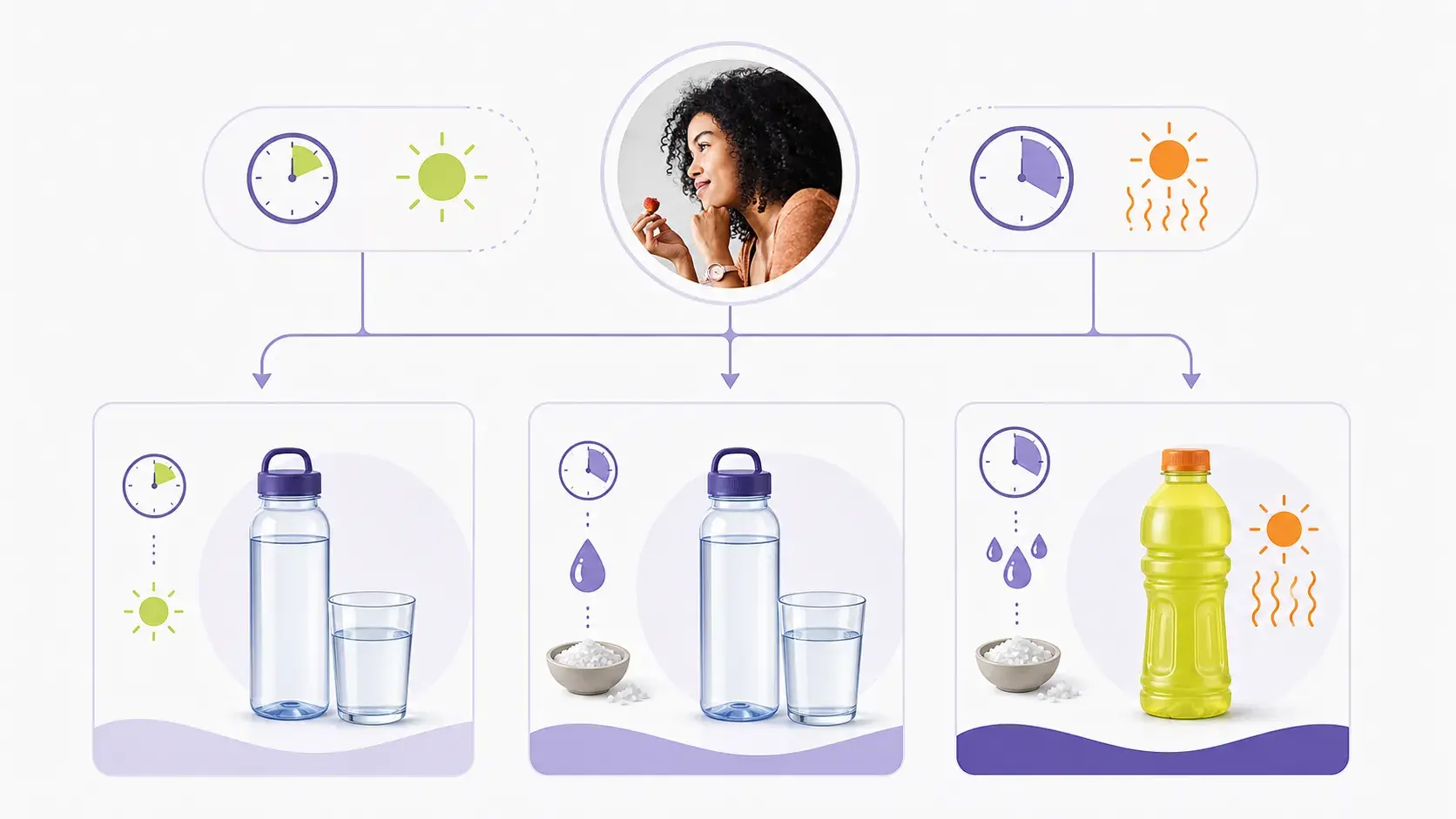
If you are wondering what to drink before, during, and after your workouts, here is a simple framework:
Most workouts
- Drink water before exercise
- Sip water during exercise as needed
- Continue drinking water after exercise
Longer or hotter training sessions
- Drink water
- Consider adding some sodium or electrolytes
- Focus on replacing fluids lost through sweat
Endurance events or extended training
- Water plus electrolytes may be appropriate
- Carbohydrate-containing sports drinks can sometimes be beneficial for prolonged efforts
That is usually enough structure for most people.
You do not need a chemistry degree to hydrate well.
You just need to understand the demands of your workout.
How to Tell If Your Hydration Strategy Is Working
The body gives you some useful clues.
Things that may suggest hydration is going reasonably well include:
- you are not excessively thirsty
- your urine is generally pale yellow
- your energy feels stable during normal training
- you recover from sessions without feeling unusually depleted
On the other hand, if you are routinely finishing workouts feeling lightheaded, crampy, exhausted, or clearly underhydrated, then it may be time to look more closely at your fluid and electrolyte strategy.
Again, this does not automatically mean you need a branded sports drink.
It may simply mean you need:
- more consistent water intake
- more sodium in long or hot sessions
- better overall hydration before the workout starts
The Best Place to Start Is Usually the Simplest
There is a reason water remains the default. It works. For the average gym-goer, runner, walker, or fitness enthusiast, hydration does not need to be expensive or complicated. You do not need a product for every session. You do not need to assume that colorful equals effective. And you do not need to believe that plain water is somehow “not enough” for a normal workout. In most cases, it is enough.
The Bottom Line
Do you need sports drinks to work out? For most people, no. Water is usually all you need to stay hydrated and perform well during exercise. If you are training for extended periods, exercising in extreme heat, or losing significant amounts of sweat, adding some sodium or electrolytes may be helpful. But for the average gym-goer, runner, or fitness enthusiast, hydration does not need to be expensive or complicated. Start with water. It is simple, effective, and for most workouts, exactly what your body needs.

FAQ
Do I need a sports drink for a normal gym workout?
Usually not. For most gym workouts, plain water is enough to support hydration.
When are sports drinks actually helpful?
They can be more useful during long endurance sessions, extreme heat, heavy sweat loss, or multiple hard workouts in one day.
What electrolyte do you lose most in sweat?
Sodium is the primary electrolyte lost in sweat.[2][4]
Is water enough for strength training?
In most cases, yes. For typical strength training sessions, water is usually more than sufficient.
Can too many sports drinks be unnecessary?
Yes. Many people consume sports drinks during workouts that do not actually require them, which can add unnecessary sugar and calories without providing meaningful benefit.
Footnotes
[1] U.S. Geological Survey. “The Water in You: Water and the Human Body.” https://www.usgs.gov/special-topics/water-science-school/science/water-you-water-and-human-body
[2] American College of Sports Medicine. “Exercise and Fluid Replacement.” Medicine & Science in Sports & Exercise. 2007;39(2):377-390.
[3] MedlinePlus. “Electrolytes.” https://medlineplus.gov/electrolytes.html
[4] Gatorade Sports Science Institute. “Sodium and Hydration for Athletes.” https://www.gssiweb.org/sports-science-exchange/article/sse-173-sodium-and-hydration-for-athletes
Extreme Heat Disclaimer
This article is intended for typical workouts and everyday exercise, not prolonged activity or work in extreme heat.
If you are exercising or working outside for long periods in very hot conditions, hydration needs may be different. Water may still be appropriate in some situations, but longer exposure, heavier sweating, and high heat can increase the need for added electrolytes and closer monitoring.
If you start to feel dizzy, weak, nauseated, confused, or unable to cool down, stop activity, move to a cooler environment, and seek medical attention if symptoms are severe or getting worse.
Sources:
OSHA: Water. Rest. Shade.
CDC/NIOSH: Heat Stress and Workers




.svg)