

What Are Macros and Should I Track Them?
Written by: Ellie Hiller | BSN, RN, HSN Nutrition Coach
What is a macronutrient?
Let’s start by defining our terms: “macro” means “large,” and “nutrient” means “to nourish.” So, in simple terms, a macronutrient, or “macro,” is a substance that human beings need in large quantities to support normal body function and overall health.[1][2]
Let’s break it down even further. There are three subcategories of macronutrients, and you’ve probably heard of them: protein, fats, and carbohydrates.[1][2][3]
These three macronutrients are the main ways our bodies take in energy, also known as calories.[4]
Protein is often referred to as the building block. Your body needs protein to build and maintain muscle, along with bones and other tissues.[1]
Dietary fat is vital for energy, nutrient absorption, and healthy body function. It also helps your body absorb fat-soluble vitamins like A, D, E, and K.[2]
Carbohydrates are the fuel. As gas is to a car, so are carbohydrates to your body. Your body breaks carbohydrates down into glucose, which is the main source of energy for your cells, tissues, and organs.[3]
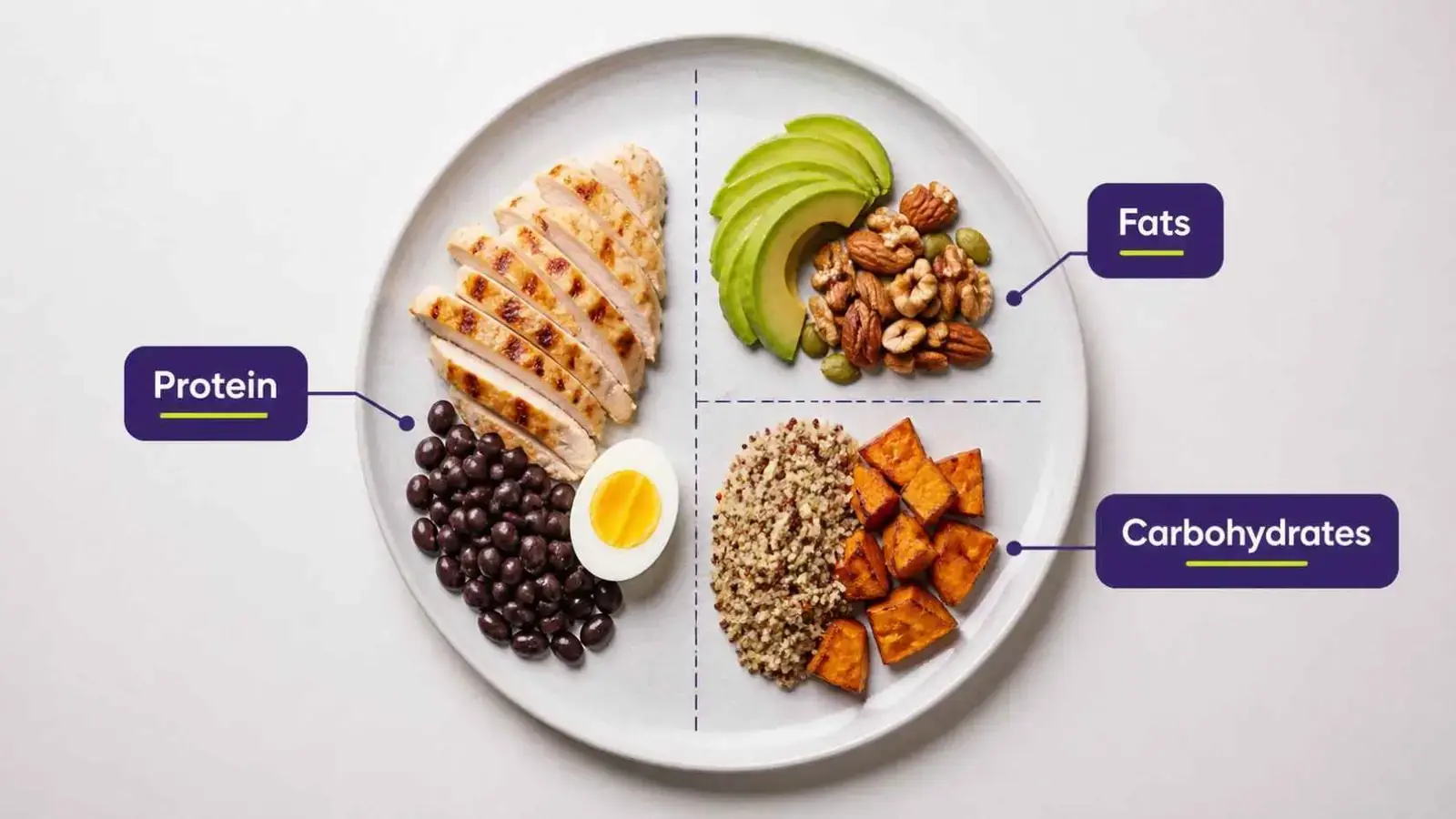
All three macronutrients play an important role in your health, and when eaten in the right quantities from real-food sources, they work together to support energy, satisfaction, and overall nutrition.[4]
Should I track how much protein, fat, and carbs I am getting each day?
To start, there can be a benefit to knowing how your calories are distributed throughout the day. In a perfect world, we want a good mix of all three macros in a day.[4]
For example, someone might be unaware that 80% of their calories are coming from carbohydrates while protein and fat are consistently too low. That would be one example of an imbalanced intake, and tracking could be a helpful awareness practice.
Tracking is not necessary for everyone, but it can be useful for people who want to:
- Learn what balanced meals actually look like
- Increase protein intake
- Support body composition goals
- Understand eating patterns they may not notice otherwise

Four principles to keep in mind if you choose to track macros
1. Protein is king
Start by tracking protein intake first. Protein is often the hardest macronutrient for people to get enough of, and it can also be very filling. It is especially important for preserving muscle, which is a precious commodity for long-term health and metabolic function.[1]
Many people do not need to track carbs and fat forever. If you are getting enough protein and eating mostly real food, you may not need to micromanage the other two long term.
2. Tracking should not be chronic
The goal with tracking is awareness.
It takes practice to eyeball what 1 tablespoon of peanut butter or 4 ounces of chicken breast looks like. That may require measuring and tracking for a few weeks to get the hang of it. It usually is not sustainable, necessary, or enjoyable to track everything forever.
A better long-term goal is learning how much protein you want on your plate at each meal, getting familiar with portions, and then setting tracking aside when it is no longer helping.
3. Find an app that makes it easy
If you choose to track macros, the key is to find an app that is easy to use. With AI, there are now apps where you can snap a picture of your plate and get an estimate of the macronutrients and calories. Of course, that is not perfect, but for many people it is good enough to build awareness.
Outside of AI tools, some well-known tracking apps include MyFitnessPal and Cronometer.
4. Do not overcomplicate it
Macronutrients do not need to become a math problem at every meal.
When you eat a real-food-forward diet and equip yourself with some basic knowledge about why each macronutrient matters, you create a solid foundation that does a lot of the heavy lifting for you. Tracking can be a helpful short-term tool for awareness, but the real goal is learning how to build balanced meals intuitively so you can thrive without overthinking it.
The Bottom Line
Macros matter because protein, fats, and carbohydrates each play a different role in your health. You do not need to obsess over them to eat well, but understanding them can make it easier to build balanced meals and spot gaps in your intake.
If tracking helps you learn, use it as a tool. If it starts making food feel stressful or overly complicated, it may be time to step back and return to the bigger picture: enough protein, mostly real food, and balanced meals you can actually sustain.
Next Steps
Ready to take control of your health with GobyMeds? See what your journey could look like with the support of GobyMeds. Click here to start your intake and see if GobyMeds is a fit for you.
Footnotes
[1] MedlinePlus. “Dietary Proteins.” https://medlineplus.gov/dietaryproteins.html
[2] MedlinePlus. “Dietary Fats.” https://medlineplus.gov/dietaryfats.html
[3] MedlinePlus. “Carbohydrates.” https://medlineplus.gov/carbohydrates.html
[4] National Academies of Sciences, Engineering, and Medicine. “Acceptable Macronutrient Distribution Ranges.” https://www.nationalacademies.org/read/27957/chapter/5




.svg)