

Understanding Your Testosterone Options at GobyMeds: Injectable TRT, Topical Cream, Hypospray, and Enclomiphene
Men exploring testosterone care through GobyMeds now have four different options to understand:
Injectable testosterone cypionate
Topical testosterone cream
Testosterone hypospray
Enclomiphene
At first glance, it may seem like these are just different ways to “treat low T.” But they are not all the same type of treatment.
Injectable testosterone cypionate, topical testosterone cream, and testosterone hypospray are all forms of testosterone replacement therapy, or TRT. They provide testosterone from outside the body.
Enclomiphene works differently. Instead of replacing testosterone directly, it supports the body’s own hormone signaling with the goal of helping the body produce more of its own testosterone.
That difference matters, especially when fertility, age, lifestyle, symptoms, and lab results are part of the conversation.
First: Replacement vs. Support
The easiest way to understand these options is to split them into two categories.
Direct testosterone replacement:
- Injectable testosterone cypionate
- Testosterone hypospray
- Topical testosterone cream
These options add testosterone into the body directly.
Testosterone support:
- Enclomiphene
This option does not add testosterone directly. It works through the body’s hormone signaling system.
Neither category is automatically better. The right fit depends on your symptoms, testosterone levels, medical history, fertility goals, and provider review.
Option 1: Injectable Testosterone Cypionate
Injectable testosterone cypionate is one of the most traditional forms of TRT. It uses testosterone from outside the body to help raise testosterone levels in men with confirmed testosterone deficiency.
Because it is direct replacement, it does not depend on the body increasing testosterone production on its own. The medication supplies testosterone directly.
Injectable TRT may be a good fit for men who:
- Have lab-confirmed low testosterone
- Have symptoms that match testosterone deficiency
- Want a direct replacement option
- Are comfortable with injections
- Prefer a weekly or provider-directed routine
- Are not currently prioritizing fertility
Pros of injectable testosterone cypionate
One of the biggest benefits of injectable TRT is that it is direct. If a man truly has low testosterone and is an appropriate candidate, injectable testosterone can be a straightforward way to restore testosterone into a provider-guided range.
It can also be easier for people who prefer a less frequent routine compared with daily medication. For some men, one scheduled injection is easier to remember than something taken or applied every day.
Considerations with injectable TRT
The biggest consideration is fertility. Exogenous testosterone can suppress the body’s natural testosterone signaling, which may reduce sperm production. For men who are actively trying to conceive or want to preserve fertility, this is a major part of the decision.
Injectable TRT also requires ongoing monitoring. Providers may check testosterone levels, blood counts, hematocrit, blood pressure, symptoms, and other safety markers over time.
TRT is not a “set it and forget it” treatment. It is structured hormone care.
Option 2: Topical Testosterone Cream
Topical testosterone cream is another direct TRT option. Instead of using an injection, testosterone is applied to the skin and absorbed into the body.
This may be a good option for men who are interested in testosterone replacement but prefer a needle-free routine. Like injectable TRT, topical testosterone cream still contains testosterone, so it belongs in the TRT category.
Topical testosterone cream may be a good fit for men who:
- Have lab-confirmed low testosterone
- Want direct testosterone replacement
- Prefer a needle-free option
- Can follow daily application instructions consistently
- Want an alternative to injectable TRT
- Are not currently prioritizing fertility
Pros of topical testosterone cream
The main benefit of topical testosterone cream is that it avoids injections while still providing direct testosterone replacement. For men who feel uncomfortable with needles, a topical option may feel more approachable.
It may also fit well for patients who prefer a daily routine and like the simplicity of applying medication as directed rather than preparing an injection.
Considerations with topical testosterone cream
Because topical testosterone cream contains testosterone, it carries many of the same broader considerations as other TRT options. That includes lab monitoring, symptom tracking, side effect monitoring, and discussion about fertility.
Topical testosterone also requires careful application. Patients should follow their pharmacy and provider instructions exactly, wash their hands after applying, allow the medication to dry, and avoid skin-to-skin transfer to others. This is especially important around women and children.
Some men may also experience skin irritation or variable absorption. As with all testosterone options, the goal is not just convenience. The goal is safe, consistent, provider-guided treatment.
Option 3: Testosterone Hypospray
Testosterone hypospray is another direct testosterone option. Instead of using a needle, it delivers testosterone through a spray format, which may feel more approachable for men who are interested in TRT but prefer to avoid injections.
The key point is this:
Testosterone hypospray is still testosterone replacement.
Even though it is needle-free, it is not the same as enclomiphene. Since it contains testosterone, it belongs in the TRT category.
Testosterone hypospray may be a good fit for men who:
- Have lab-confirmed low testosterone
- Want direct testosterone replacement
- Prefer a needle-free option
- Can follow application instructions consistently
- Want an alternative to injectable TRT
- Are not currently prioritizing fertility
Pros of testosterone hypospray
The main benefit is convenience for men who do not want injections. Some patients like the idea of direct testosterone replacement but feel hesitant about needles. A spray format may feel more approachable.
It may also fit better into a daily routine for patients who prefer smaller, more regular dosing rather than an injection schedule.
Considerations with testosterone hypospray
Because hypospray contains testosterone, it may carry many of the same broader considerations as other TRT options. That includes the need for lab monitoring, symptom tracking, and discussion about fertility.
Depending on the formulation and application route, patients may also need to be careful about timing, absorption, skin or mucosal irritation, and following pharmacy-specific instructions exactly.
This is not a medication to freestyle. Use it exactly as prescribed.
Option 4: Enclomiphene
Enclomiphene is different from injectable testosterone, topical testosterone cream, and testosterone hypospray.
It is not classic TRT because it does not replace testosterone directly. Instead, enclomiphene works through the body’s hormone signaling system. It helps encourage the brain and pituitary to send stronger signals to the testes, which may help the body produce more of its own testosterone.
That is why enclomiphene is often better described as testosterone support.
Enclomiphene may be a good fit for men who:
- Want to support natural testosterone production
- Prefer an oral option
- Are younger or still in peak fertility years
- Want to avoid direct testosterone replacement
- Want to keep fertility in the conversation
- Have labs suggesting their body may still respond to signaling support
Pros of enclomiphene
The biggest benefit of enclomiphene is that it works with the body’s own testosterone pathway rather than replacing testosterone from the outside.
That matters for fertility. Traditional TRT can suppress sperm production, while enclomiphene is often considered a more fertility-conscious option because it supports LH and FSH signaling, which are involved in natural testosterone and sperm production.
It is also oral, which many patients prefer.
Considerations with Enclomiphene
Enclomiphene is not the same as testosterone replacement. That is both a benefit and a limitation.
Because it depends on the body’s ability to respond to hormone signals, it may not be the right fit for every man. If the testes are not able to respond well, a stimulation-based approach may not be enough.
It still requires lab work, provider review, and follow-up. Oral does not mean casual.
Comparing the Four Options
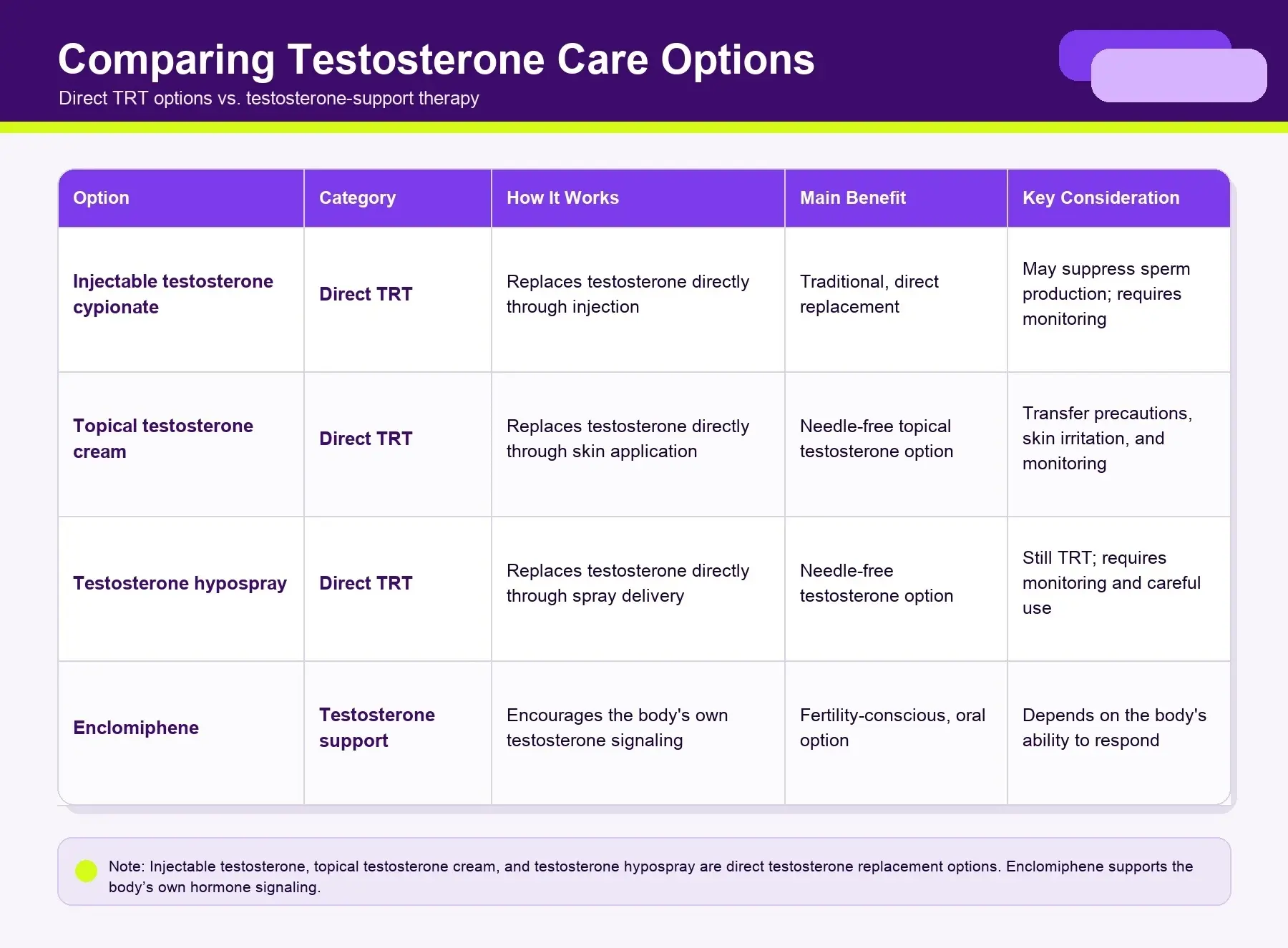
Which Option Makes the Most Sense?
The right option is not based only on preference. It should be based on the full picture.
A provider may consider:
- Symptoms
- Total and free testosterone levels
- LH and FSH levels
- Age
- Fertility goals
- Medical history
- Medication history
- Blood pressure
- Hematocrit and blood counts
- Lifestyle and routine preferences
- Comfort with injections, sprays, or pills
For some men, injectable TRT may be the most appropriate path. For others, testosterone hypospray or a topical cream may offer a needle-free direct replacement option. For men who want to keep fertility front and center, enclomiphene may be the better conversation.
Fertility: The Big Difference
Fertility is one of the most important differences between these options.
Injectable testosterone, topical testosterone cream, and testosterone hypospray all provide testosterone from outside the body. Because of that, they may suppress the body’s natural hormone signaling and reduce sperm production.
Enclomiphene works differently. It supports the signaling pathway involved in natural testosterone production and sperm production, which is why it may be a better option for men who want to preserve fertility.
If you are actively trying to conceive, planning to have children, or unsure about future fertility goals, bring that up before starting any testosterone plan.
Monitoring Still Matters
No matter which option you choose, testosterone care should include follow-up.
That may include monitoring:
- Testosterone levels
- Symptoms
- Hematocrit and hemoglobin
- Blood pressure
- Side effects
- Estradiol when appropriate
- Fertility goals
- Sleep, mood, libido, and energy
The goal is not simply to raise a number. The goal is to improve symptoms safely and sustainably.
The GobyMeds Approach
At GobyMeds, testosterone care is not one-size-fits-all. Different men have different goals, different labs, and different concerns.
Some men want the directness of injectable TRT. Some want a needle-free direct testosterone option like topical cream or hypospray. Others want to support their own testosterone production and keep fertility in mind, making enclomiphene the more relevant discussion.
The best plan is the one that matches your body, your goals, and your stage of life.
The Bottom Line
GobyMeds offers four testosterone care paths:
Injectable testosterone cypionate, a direct TRT option delivered by injection.
Topical testosterone cream, a direct TRT option applied to the skin.
Testosterone hypospray, a needle-free direct testosterone option delivered by spray.
Enclomiphene, an oral testosterone-support option that works through the body’s own hormone signaling.
Injectable testosterone, topical testosterone cream, and testosterone hypospray are testosterone replacement options. Enclomiphene is different. It supports natural production rather than replacing testosterone directly.
FAQ
Is testosterone hypospray the same as injectable TRT?
Not exactly. They are different delivery methods, but both contain testosterone and are considered direct testosterone replacement options.
Is enclomiphene TRT?
No. Enclomiphene is better described as testosterone support because it helps encourage the body’s own testosterone production instead of replacing testosterone directly.
Which option is best for fertility?
Enclomiphene is often the more fertility-conscious option because it supports the body’s own hormone signaling. Direct testosterone options, including injections and hypospray, may suppress sperm production.
Is hypospray better than injections?
Not necessarily. It may be better for someone who wants a needle-free option, but the best choice depends on labs, symptoms, lifestyle, and provider guidance.
Do all four options require labs?
Yes. Testosterone care should include baseline labs and follow-up monitoring.
Can I switch from one option to another?
Sometimes, but this should be done with provider guidance. Switching testosterone treatments can affect symptoms, testosterone levels, side effects, and fertility considerations.
Is topical testosterone cream considered TRT?
Yes. Topical testosterone cream contains testosterone, so it is a form of testosterone replacement therapy. It is different from enclomiphene, which supports the body’s own testosterone signaling rather than replacing testosterone directly.
Is topical testosterone cream better than injections?
Not necessarily. It may be better for someone who wants a needle-free option, but the best choice depends on labs, symptoms, lifestyle, fertility goals, and provider guidance.
Can topical testosterone cream transfer to other people?
Yes, topical testosterone can transfer through skin contact if it is not used carefully. Patients should follow application instructions, wash their hands after applying, allow the medication to dry, and avoid skin-to-skin contact with the application area as directed.
Sources
- Endocrine Society: Statement on Testosterone Replacement Therapy
https://www.endocrine.org/news-and-advocacy/news-room/2026/statement-on-testosterone-replacement-therapy - Endocrine Society Clinical Practice Guideline: Testosterone Therapy in Men With Hypogonadism
https://academic.oup.com/jcem/article/103/5/1715/4939465 - American Urological Association: Evaluation and Management of Testosterone Deficiency
https://www.auajournals.org/doi/abs/10.1016/j.juro.2018.03.115 - AUA/ASRM Guideline: Diagnosis and Treatment of Infertility in Men
https://www.asrm.org/practice-guidance/practice-committee-documents/diagnosis-and-treatment-of-infertility-in-men-aua-asrm-guideline-part2/ - FDA: Testosterone Information
https://www.fda.gov/drugs/postmarket-drug-safety-information-patients-and-providers/testosterone-information - DailyMed: Natesto Testosterone Nasal Gel Prescribing Information
https://dailymed.nlm.nih.gov/dailymed/fda/fdaDrugXsl.cfm?setid=dea6bed1-eaca-11e3-ac10-0800200c9a66 - MedlinePlus: Testosterone Topical
https://medlineplus.gov/druginfo/meds/a605020.html
Disclaimer: This article is for informational purposes only and does not constitute medical advice. Testosterone therapy and testosterone-support medications should only be used under the supervision of a licensed healthcare provider after appropriate evaluation and lab testing.




.svg)