
Low Testosterone or Burnout? How to Tell the Difference
Written by: GobyMeds Editorial Team
Not every tired, unfocused, unmotivated man has low testosterone. And not every man with low testosterone is simply burned out. That is what makes this question so important.
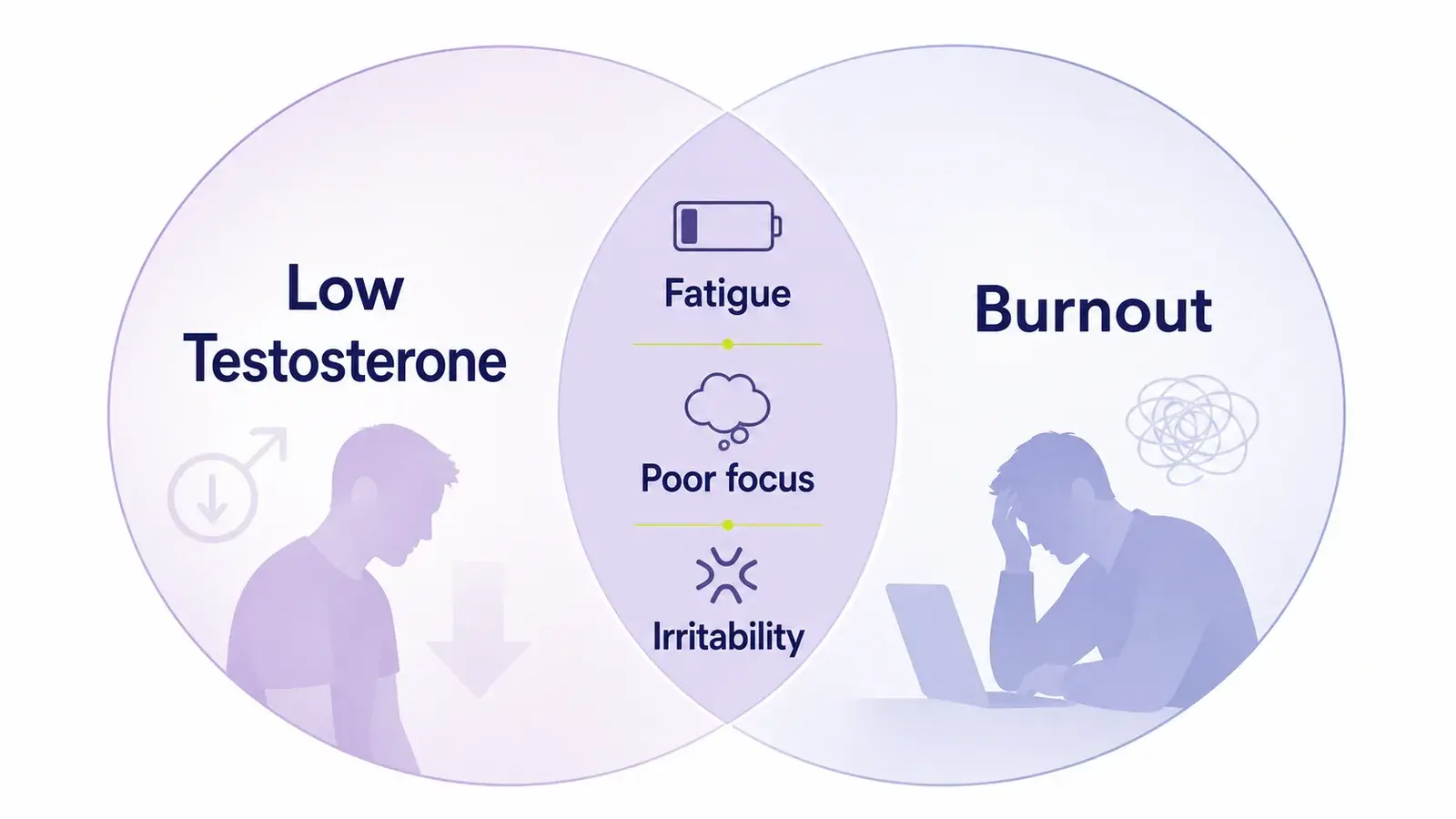
Low testosterone and burnout can look similar on the surface. Both can show up as fatigue, lower drive, poor concentration, irritability, and the feeling that something is off. But they are not the same thing, and confusing one for the other can lead men down the wrong path.
Low testosterone is a medical issue that requires symptoms plus consistently low testosterone levels on lab testing.[1][2] Burnout, by contrast, is defined by the World Health Organization as an occupational phenomenon that results from chronic workplace stress that has not been successfully managed.[3]
In other words, one is a hormone-related medical concern. The other is a stress-related pattern. They can overlap. They can mimic each other. And in some cases, they can absolutely exist at the same time. That is why the real goal is not to guess.
The real goal is to understand what points more strongly in one direction versus the other, and when lab work needs to enter the conversation.

Why Low Testosterone and Burnout Get Confused
Part of the confusion is that the overlap is real. A man with burnout may feel mentally drained, flat, less motivated, more irritable, and less effective day to day. A man with low testosterone may also describe reduced energy, mood changes, poor concentration, and less physical resilience.[1] That means symptoms alone do not always tell the full story.
This is also one reason hormone content online can be misleading. A list of vague symptoms like fatigue, brain fog, low motivation, and poor sleep can make almost anything sound like low testosterone. But guideline-based testosterone care does not diagnose low T from vibes, social media lists, or a single bad week.
The Endocrine Society recommends diagnosing hypogonadism only in men who have symptoms and signs consistent with testosterone deficiency and unequivocally and consistently low testosterone concentrations.[2] That is the key distinction. Symptoms matter. But symptoms alone are not enough.
What Burnout Actually Is
Burnout is often used casually, but the formal definition is narrower than many people realize. According to the World Health Organization, burnout is an occupational phenomenon, not a medical condition.[3] WHO describes it as resulting from chronic workplace stress that has not been successfully managed and characterizes it by three dimensions:[3]
- feelings of energy depletion or exhaustion
- increased mental distance from one’s job, or feelings of negativism or cynicism related to the job
- reduced professional efficacy
That definition matters because it highlights something very specific: Burnout is not simply “being tired.” It is a pattern of exhaustion, detachment, and reduced effectiveness that is rooted in chronic stress, especially work-related stress. That does not mean people use the word incorrectly in everyday life. Many men say “burned out” when they really mean overwhelmed, overextended, emotionally flat, or chronically stressed. But clinically and practically, the stress pattern still matters.
If symptoms seem tightly connected to workload, pressure, emotional depletion, and mental distance from work, burnout becomes a more relevant explanation.
What Low Testosterone Actually Is
Low testosterone, or male hypogonadism, is not defined by fatigue alone. It is a combination of symptoms plus low testosterone confirmed on repeat testing.[1][2]
The Endocrine Society patient resource notes that diagnosis requires at least two early-morning blood tests showing low testosterone along with symptoms or signs typical of low testosterone.[1] The Society’s guideline similarly recommends making the diagnosis only when symptoms and signs are present along with unequivocally and consistently low testosterone levels, and recommends confirming the diagnosis by repeating morning fasting testosterone testing.[2] That matters because testosterone levels naturally fluctuate. They are usually highest in the morning.[1]
A single borderline result, especially without a matching symptom pattern, is not the same thing as proven testosterone deficiency.
Symptoms That Overlap
This is where the confusion usually starts. Both low testosterone and burnout may involve:
- low energy
- poor focus or reduced concentration
- irritability
- lower motivation
- poor recovery
- sleep disruption
- reduced sense of resilience
Because those symptoms overlap so much, many men start by assuming one explanation and never investigate the other. That is not always a safe assumption.
Symptoms That Point More Strongly Toward Low Testosterone
Some symptoms are much more suggestive of low testosterone than burnout alone.
According to the Endocrine Society, symptoms and signs of male hypogonadism can include:[1]
- lower sex drive
- erectile dysfunction
- loss of spontaneous erections
- reduced sperm count and infertility
- reduced energy
- reduced muscle mass
- increased irritability or difficulty concentrating
- depressed mood
Over time, low testosterone may also be associated with loss of body hair, loss of muscle bulk, weak bones, low red blood cells, and smaller testes.[1]
That means the conversation starts to lean more toward low testosterone when the picture includes sexual symptoms plus physical change, not just feeling worn down.
Patterns that may raise more suspicion for low testosterone include:
- low libido that is persistent rather than occasional
- erectile changes or fewer spontaneous erections
- noticeable loss of muscle mass or strength
- increased body fat alongside declining performance or recovery
- symptoms that persist even when work stress temporarily eases
None of those automatically proves low testosterone, but they are harder to explain by burnout alone.
Symptoms That Point More Strongly Toward Burnout
Burnout tends to look more like stress-system overload than hormone deficiency. The WHO definition centers on exhaustion, mental distance or cynicism related to work, and reduced professional effectiveness.[3]
That means the picture leans more toward burnout when symptoms are dominated by:
- emotional exhaustion
- dread, detachment, or cynicism about work
- a sense of being constantly “on”
- reduced productivity or professional effectiveness
- stress that feels environment-driven rather than body-driven
In simpler terms, burnout often carries more of a context clue.
The symptoms are frequently tied to a schedule, a workload, a role, or a chronic pressure pattern. That does not make them less real. It just means the root cause may be different.
The Telltale Difference: Sexual Symptoms Usually Matter
One of the most useful practical distinctions is this: Burnout can absolutely reduce interest in almost everything. But low testosterone more often brings clear sexual symptoms into the picture.
That includes things like:
- reduced libido
- erectile changes
- fewer spontaneous erections
- fertility concerns
Those symptoms do not automatically equal low testosterone, but they are part of why hormone evaluation becomes more relevant. If the primary complaint is, “work is exhausting, motivation is shot, and everything feels heavy,” burnout may be more plausible.
If the picture also includes reduced sex drive, changes in erections, muscle loss, and a broader decline in physical vitality, low testosterone deserves a closer look.
Low Testosterone and Burnout Can Happen at the Same Time
This is the nuance many articles miss. It is not always an either-or situation.
A man can be under chronic stress and have low testosterone. A man can be burned out, sleeping poorly, and also have a true hormone deficiency. A man can also think the problem is low T when the bigger issue is stress, sleep, overwork, or another medical factor. That is why careful evaluation matters.
Other Conditions That Can Look Like Either One
Another reason this conversation gets tricky is that low energy and poor performance are not unique to low testosterone or burnout.
The Endocrine Society notes that low testosterone can be associated with obesity, sleep disorders, type 2 diabetes, chronic illness, certain medications such as opioids and corticosteroids, and disorders affecting the testes, pituitary, or brain.[1]
That means a man with “low T symptoms” may actually be dealing with:
- poor sleep or sleep apnea
- chronic stress overload
- medication effects
- obesity or metabolic dysfunction
- another underlying medical issue
This is one reason responsible testosterone care should never begin and end with a marketing quiz. The question is not just whether symptoms exist. The question is what is causing them.

What a Real Evaluation Should Include
If low testosterone is on the table, a real evaluation should look at more than fatigue alone. A clinician should generally consider:
- the full symptom pattern
- sexual symptoms
- sleep quality
- stress and workload
- medications
- body composition and physical change
- relevant medical history
- repeat morning testosterone testing
The Endocrine Society specifically recommends repeating morning fasting testosterone testing to confirm the diagnosis and recommends further evaluation to identify the cause of androgen deficiency.[2] That step matters because treatment decisions should be built on evidence, not guesswork.
Why Lab Work Is the Turning Point
This is where low testosterone and burnout finally separate in a meaningful way. Burnout does not get diagnosed with a testosterone lab result. Low testosterone does.
A man may feel exhausted, flat, and mentally cooked for months and still have normal testosterone. Another man may blame work stress for everything and turn out to have clearly low morning testosterone on repeat testing.
That is why lab work changes the conversation from speculation to actual clinical decision-making.
Where GobyMeds Fits In
At GobyMeds, the better approach is not to assume every tired or foggy man needs testosterone.
The better approach is to start with symptoms, lab work, and clinician review. If the picture points toward true testosterone deficiency, that opens the door to a more informed hormone conversation.
If the labs do not support low testosterone, that matters too. It helps prevent the wrong treatment path and pushes the evaluation back toward stress, sleep, workload, recovery, or other medical contributors.
That is what responsible testosterone care should look like:
- symptoms taken seriously
- lab work done correctly
- treatment decisions based on the full picture

The Bottom Line
Low testosterone and burnout can look similar, but they are not the same.
Burnout is a stress-related occupational phenomenon marked by exhaustion, cynicism or detachment, and reduced professional effectiveness.[3]
Low testosterone is a medical issue that should be diagnosed only when symptoms and signs are present alongside consistently low testosterone on repeat testing.[1][2]
The biggest clues that tilt the picture more toward low testosterone are usually sexual symptoms, physical changes such as reduced muscle mass or increased body fat, and lab-confirmed low testosterone.
The biggest clues that tilt the picture more toward burnout are chronic stress, emotional exhaustion, mental distance from work, and reduced work effectiveness.
And sometimes, both are part of the same story.
That is why men with persistent symptoms deserve more than a guess. They deserve a real evaluation.
And if you think you might be experiencing low testosterone, GobyMeds will be offering testosterone support therapy soon for men at varying stages of life. Make sure you are following GobyMeds on Instagram or TikTok to be among the first to know when testosterone support therapy is available.
FAQs about Low Testosterone and Burnout
Can burnout feel like low testosterone?
Yes. Burnout and low testosterone can overlap in fatigue, poor focus, irritability, lower motivation, and reduced resilience. That is one reason symptoms alone are not enough to diagnose low testosterone.[1][2][3]
What symptoms point more strongly to low testosterone?
Symptoms that point more strongly toward low testosterone include low libido, erectile changes, loss of spontaneous erections, reduced muscle mass, and other physical signs of testosterone deficiency.[1]
What symptoms point more strongly to burnout?
Burnout is more strongly associated with exhaustion, cynicism or mental distance related to work, and reduced professional effectiveness.[3]
Can a man have both low testosterone and burnout?
Yes. The two are not mutually exclusive. Chronic stress and poor recovery can coexist with true testosterone deficiency.
Is one testosterone test enough to diagnose low T?
No. The Endocrine Society recommends confirming the diagnosis with repeat morning testosterone testing and evaluating symptoms and signs alongside lab results.[1][2]
Footnotes
[1] Endocrine Society. “Hypogonadism in Men.” Updated January 24, 2022. https://www.endocrine.org/patient-engagement/endocrine-library/hypogonadism
[2] Endocrine Society. “Testosterone Therapy for Hypogonadism Guideline Resources.” https://www.endocrine.org/clinical-practice-guidelines/testosterone-therapy
[3] World Health Organization. “Burn-out an ‘occupational phenomenon’.” https://www.who.int/standards/classifications/frequently-asked-questions/burn-out-an-occupational-phenomenon




.svg)