
Progressive Overload: How to Get Stronger Without Getting Hurt
Everyone wants to get stronger. You hit a personal record one week, feel great, and immediately start wondering, “How much more weight can I add next time?”
That desire to progress is a good thing. In fact, progressive overload is one of the fundamental principles of strength training. But there is a problem: many lifters become so focused on getting stronger that they increase weight too aggressively. That is often when injuries happen.
The goal is not just to get stronger. The goal is to get stronger without getting hurt.
That is where the 10% Rule comes in.
What Is Progressive Overload?
Progressive overload simply means gradually increasing the demands placed on the body over time. You can do this in several ways, including:
- Increasing weight
- Increasing repetitions
- Increasing sets
- Increasing training frequency
- Increasing overall training volume
Without progressive overload, your body has no reason to adapt. If you bench press the same weight for the same number of reps every week for years, your progress will eventually stall. To continue improving, the stimulus has to gradually increase.
The key word is gradually.
The Problem With “Too Much, Too Soon”
The body adapts remarkably well to stress, but not every tissue adapts at the same speed. Muscles often adapt faster than tendons, ligaments, cartilage, and other connective tissues.
That means you may feel capable of lifting significantly more weight today, but that does not necessarily mean every part of your body is prepared for that increase.
This is where many injuries occur. The athlete feels stronger. The muscles may be ready. But the rest of the body has not fully caught up yet.
When training loads increase too rapidly, the risk of overuse injuries and tissue breakdown begins to rise.
Understanding the 10% Rule
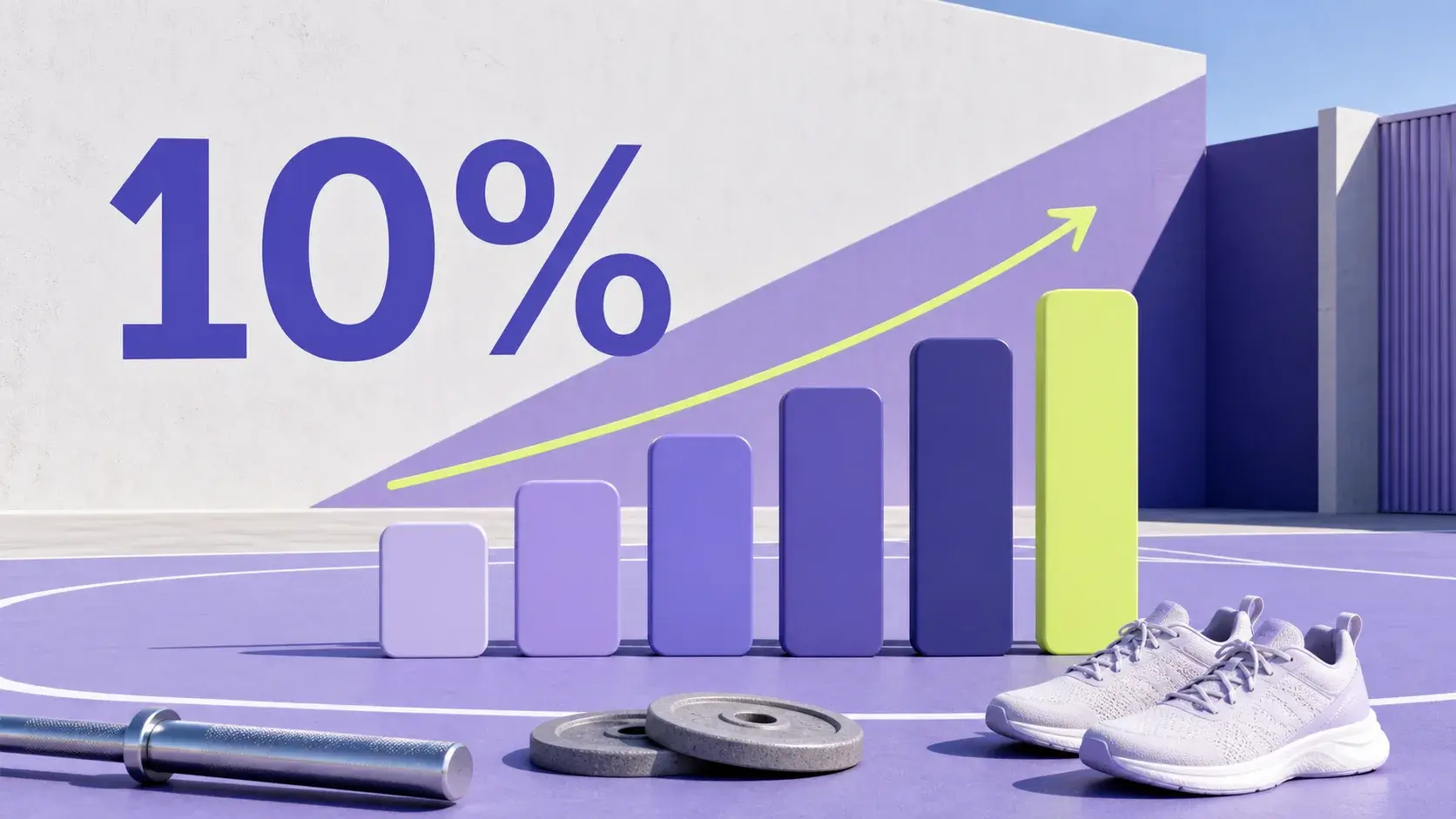
One guideline commonly used in strength and conditioning is the 10% Rule. The idea is simple: avoid increasing training volume or intensity by more than approximately 10% at a time.
For example, if you are squatting 200 pounds, a reasonable progression may be moving to 210 or 220 pounds rather than jumping immediately to 250 pounds.
The same idea applies to training volume. If you are performing 20 total sets per week for a muscle group, increasing to 22 sets is often more appropriate than suddenly jumping to 30 sets.
The goal is to provide enough stress to stimulate adaptation without overwhelming the body’s ability to recover.
Why Small Increases Lead to Bigger Results
Many people underestimate the power of consistency. Let’s say you increase your squat by just 10 pounds every few weeks. That may not sound impressive in the moment, but over the course of a year, those small increases can add up to substantial strength gains.
More importantly, you are more likely to spend time training instead of dealing with setbacks.
The strongest athletes are not always the ones who progress the fastest. They are often the ones who stay healthy long enough to continue progressing.
Strength Is Built During Recovery
One reason lifters often violate the 10% Rule is that they focus exclusively on the workout itself. But training is only one part of the adaptation process. Recovery matters just as much.
Your body needs time to:
- Repair muscle tissue
- Strengthen connective tissues
- Replenish energy stores
- Adapt to training stress
When you increase training loads too quickly, recovery becomes more difficult and injury risk increases.
The body does not get stronger during the workout. It gets stronger by recovering from the workout.

Signs You May Be Progressing Too Quickly
Your body often gives warning signs before a major injury occurs. Pay attention if you notice:
- Persistent joint pain
- Increasing soreness that does not resolve
- Declining performance
- Changes in movement mechanics
- Excessive fatigue
- Difficulty recovering between sessions
These signs may indicate that your progression is outpacing your recovery capacity. Sometimes the smartest thing you can do is slow down.
The Long-Term Approach Wins
Fitness culture often celebrates dramatic transformations and rapid progress. But sustainable strength is built through patience.
The lifter who adds weight gradually for years will almost always outperform the lifter who repeatedly gets injured chasing aggressive jumps in training load.
Progressive overload works, but progressive overload does not mean reckless overload. It means giving your body a reason to adapt while respecting its ability to recover.
The Bottom Line
If you want to get stronger, you have to challenge your body. That is the essence of progressive overload.
But do not let your enthusiasm outrun your physiology.
A good rule of thumb is to avoid increasing training volume or intensity by more than approximately 10% at a time. Small, consistent increases allow your muscles, tendons, ligaments, and joints to adapt together.
Remember: the goal is not to see how much weight you can lift next week. The goal is to keep getting stronger for years.
And the athletes who stay healthy are usually the ones who get there.

Research Corner: What the Science Says about Progressive Overload
Added by the GobyMeds Editorial Team
Progressive overload is not just gym folklore. The American College of Sports Medicine has long recognized progression as a key part of resistance training. In its guidance on resistance training progression, ACSM notes that training demands need to increase over time to keep driving adaptation. For load increases, ACSM has suggested that a 2 to 10% increase may be appropriate when someone can perform their current workload for one to two repetitions beyond the target range.
More recent research continues to support resistance training as an effective way to improve strength, muscle size, power, endurance, and physical function. A 2026 ACSM overview of reviews looked at 137 systematic reviews and more than 30,000 participants, concluding that progressive resistance training improves multiple measures of muscle function and performance.
The injury-prevention side is a little more nuanced. The exact “10% Rule” should be treated as a practical guideline rather than a universal rule for every lifter. However, the larger concept is well-supported: sudden spikes in training load can be a problem. The International Olympic Committee has identified poor load management, including rapid changes in training load, as an important injury risk factor in sport.
Strength and conditioning researcher Tim Gabbett has described this as the “training-injury prevention paradox.” Training hard can make athletes more resilient, but the way training load is increased matters. High workloads alone are not always the issue. Getting there too quickly is often where problems begin.
That is why the 10% Rule is useful. It gives lifters a simple way to slow down, manage training stress, and avoid letting motivation outrun recovery.
Sources:
- American College of Sports Medicine: Progression Models in Resistance Training for Healthy Adults
https://pubmed.ncbi.nlm.nih.gov/11828249/ - American College of Sports Medicine: Resistance Training Prescription for Muscle Function, Hypertrophy, and Physical Performance in Healthy Adults
https://pubmed.ncbi.nlm.nih.gov/41843416/ - International Olympic Committee Consensus Statement: How Much Is Too Much? Load in Sport and Risk of Injury
https://pubmed.ncbi.nlm.nih.gov/27535989/ - Tim Gabbett: The Training-Injury Prevention Paradox
https://pmc.ncbi.nlm.nih.gov/articles/PMC4789704/ - Gabbett, Hulin, Blanch, Whiteley: High Training Workloads Alone Do Not Cause Sports Injuries: How You Get There Is the Real Issue
https://pubmed.ncbi.nlm.nih.gov/26795610/




.svg)